Desert Tortoise Preserve Committee, Inc.
  • About Us
    • Our Mission
    • Board Members & Staff
    • Contact Us
  • Desert Tortoise & Habitat
    • The Desert Tortoise
    • Lifecycle of the Desert Tortoise
    • Conservation Status
    • Managing Raven Predation
    • Research & Publications
    • FAQ’s
  • DTRNA & Protected Areas
    • Overview & Location
    • Visiting the DTRNA
    • Wildlife & Trail Guides
    • Off Highway Vehicle Info
  • Captive or Found Tortoises
    • Keep Wild Tortoises Wild!
    • Captive Tortoises
  • News & Events
    • Meetings, Events, Workshops
    • News & Press Releases
    • Tortoise Tracks Newsletter
    • Volunteer Work Parties
  • Support Us
    •  
  • Click to open the search input field Click to open the search input field Search
  • Menu Menu
  • Lifecycle of the Desert Tortoise

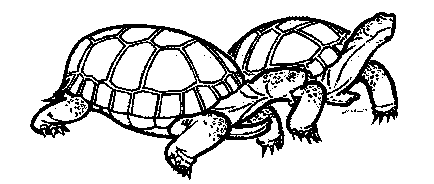
Mating may occur anytime after emergence from hibernation in March until the beginning of hibernation in October. Most mating activity is in the spring.
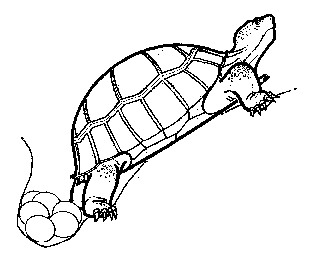
Between May and July the female usually digs a nest at a burrow entrance or near a shrub. She carefully deposits 1-14 eggs. The eggs resemble ping pong balls.

Incubating for 70 to 120 days, the hatchlings break out of the shell using an egg tooth. The yolk sac provides nourishment even after hatching.
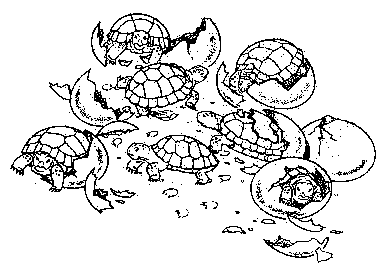
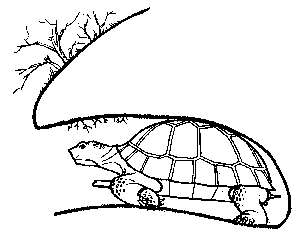
Hatchlings are about the size of silver dollars. Their shells are soft and composed mostly of scutes. Female tortoises do not provide care for theirYoung Only 1 to 5 out of every 100 hatchlings will survive to adulthood.

Growth is slow in the wild. As a tortoise grows, bone develops under the layer of scutes. By the time the tortoise is 5 years old the bone is well developed and the shell is hard. Tortoises may live to be 60 to 100 years old.
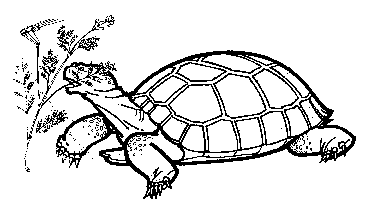
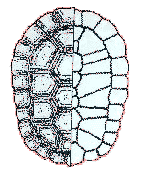
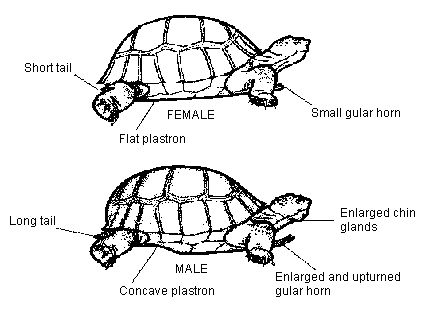
The tortoise shell has two layers with a layer of scutes over a layer of bone. In the wild, sexual maturity is reached between 14-20 years.

View/Download Our Brochures

DTRNA Brochure Plant Loop Guide Tortoise Foods Brochure

    Desert Tortoise & Habitat

  • The Desert Tortoise
  • Lifecycle of the Desert Tortoise
  • Conservation Status
  • Managing Raven Predation
  • Research & Publications
  • FAQ’s

Support Us

Become a member, subscribe, donate or find out about other ways to support the DTPC.

Support Us

4star-ratingbadge-2025 400

Desert Tortoise Preserve Committee

(442) 294-4258
email hidden; JavaScript is required

  • Link to Facebook
  • Link to LinkedIn
  • Link to Instagram

Office Address

114 B South China Lake Blvd.
Ridgecrest, California 93555

Mailing Address

PO Box 940
Ridgecrest, California 93556

  • About Us
  • Desert Tortoise & Habitat
  • DTRNA & Protected Areas
  • Captive or Found Tortoises
  • News & Events
  • Support Us
Scroll to top Scroll to top Scroll to top