
Overview
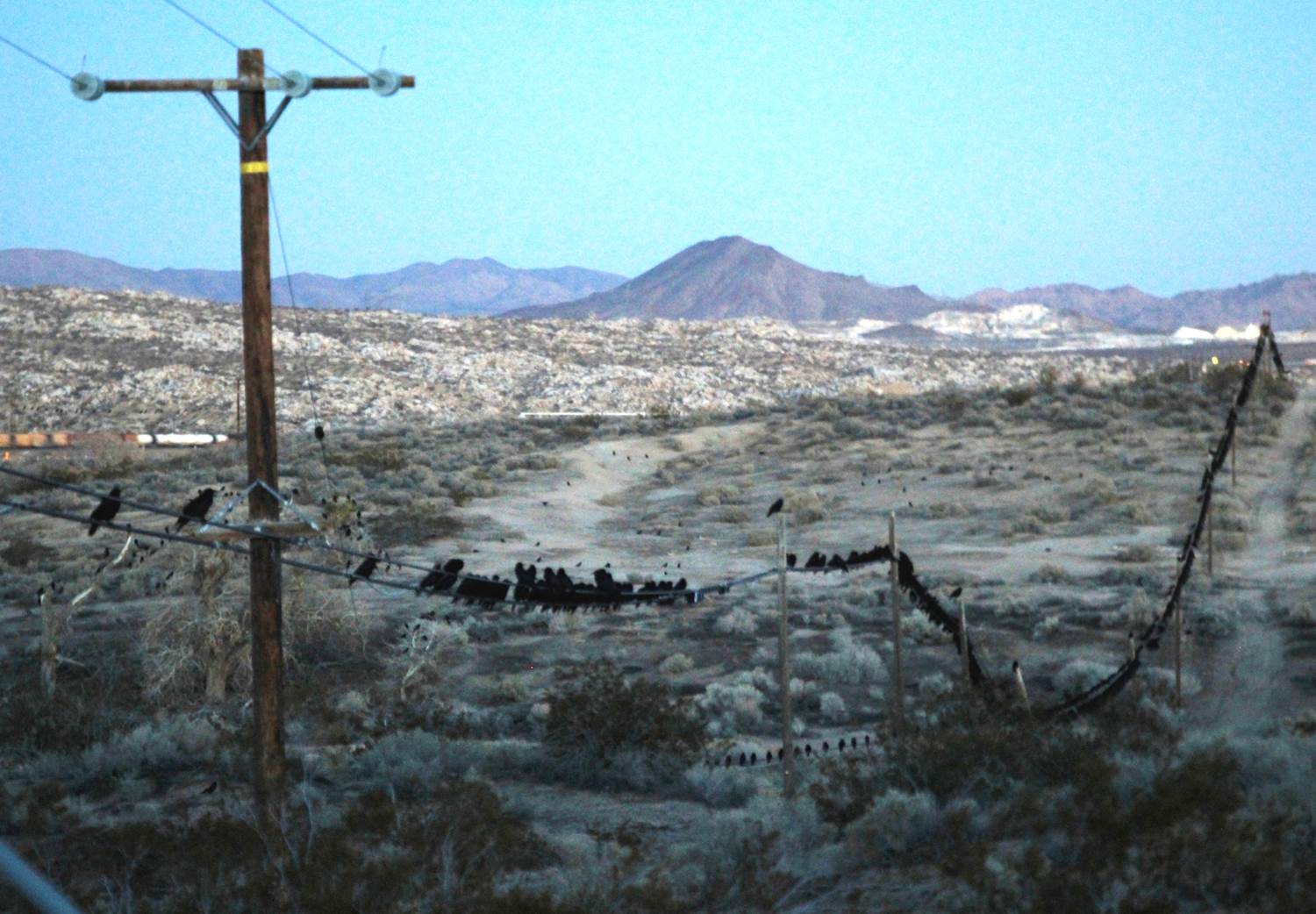 Raven overpopulation is the single biggest threat to young desert tortoises. Historically, ravens were present but uncommon in the desert. However, over the last few decades their population has exploded. The reason is simple: these highly intelligent birds have taken advantage of ever-increasing human development. Open trash containers, illegal dumping, and landfills are raven restaurants that never close; billboards, transmission poles and towers, and abandoned buildings provide abundant roosting and nesting sites.
What’s been a boon for ravens has been a disaster for tortoises. Small juvenile tortoises are no match for a raven’s sharp bill; in some areas, the birds kill almost all tortoise hatchlings. And even if a hatchling makes it through the first year, the danger isn’t over, because it can take a decade to grow big enough – around five inches – to be relatively safe from raven predation.
Enter the DTPC and the Christine & Robert Young Raven Management Fund. This fund, started with a generous gift from the Youngs and kept going with your donations, will help us pay for more hours of raven nest identification and monitoring, non-lethal hazing, and – critically – education outreach in nearby communities like California City, where the birds often too easily access trash and roosting/nesting spots.
The DTPC’s ongoing strategy is to locate raven nests, and once they’re found, use drones to spray non-toxic mineral oil on the eggs. The oil doesn’t harm the birds, but prevents the eggs from hatching. By the time the birds realize their eggs aren’t going to hatch, it’s too late in the season for another clutch. Some birds will even abandon an unsuccessful nest completely.

This work has already paid off. In areas we monitor and egg-oil, in and around the Desert Tortoise Research Natural Area, raven numbers have decreased. That’s great news for young tortoises. But this is not a one or two year project. Ravens are smart, and if we stop our control efforts, they’ll figure it out and simply come back.
Reducing raven numbers is probably the single most impactful thing we can do to protect juvenile tortoises, and we are grateful to the Youngs for their thoughtful and incredibly useful donation. If you’d like to help us do this critical work, please visit our Ways to Give page.
By the way, the DTPC has long worked with partners on this problem. Starting in 2015, we partnered with a diverse range of environmental and business stakeholders to create the Coalition for a Balanced Environment (CBE). CBE’s groundbreaking work included scientific and policy analysis of this complex issue, and implementation of pilot programs for dealing with growth of raven populations.
 Since then we’ve also worked with biologist Tim Shields at OrniLogic, who has pioneered several creative, non-lethal ways of discouraging ravens from using nesting and feeding sites (including the above-mentioned egg-oiling), and even ways of teaching the birds to avoid baby tortoises.
These successful initial efforts now provide the foundation for expanded programming supported by the Christine & Robert Young Raven Management Fund.
About CBE California
In late 2015, a group of highly respected environmentalists and industry leaders formed The Coalition for a Balanced Environment (CBE). The Coalition will work to enhance and refine raven management practices throughout California, as this is a serious issue which has ramifications for other wildlife species, agriculture and ranching, and overall environmental health. Through enhanced raven management practices, the CBE will move towards its ultimate goal of restoring balance to the California Desert ecosystem and other ecosystems throughout the State.
More Info
- CBE Position Paper
- Environmental Assessment to Implement a Desert Tortoise Recovery Plan Task: Reduce Common Raven Predation on the Desert Tortoise
- Finding of no significant impact (FONSI) – Desert Tortoise Recovery Plan
- Invasion of the Tortoise Snatchers – Ravens in the Mojave Desert
- Report: CBE Kerm County Raven Subsidy Reduction Pilot